Lifecycle
The Bigsby request lifecycle is composed of a number of stages that revolve around validation, parsing, authentication, execution and error handling.

Hooks
Bigsby exposes hooks that enable the creation of complex and powerful request workflows.
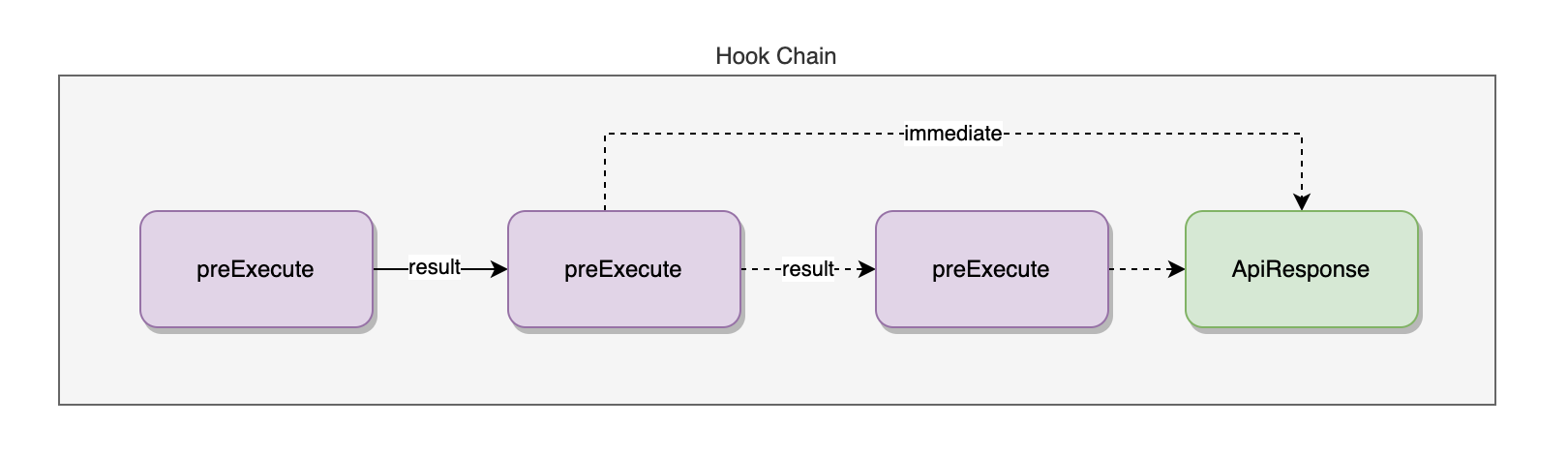
- Each hook accepts an array of functions known as
HookChains. - Hooks can optionally return a
HookResultwhich includes aResponseBuilder. - Each hook in the chain will receive the
ResponseBuilderreturned by the previous hook (unless it's immediate). - The resulting
ApiResponseproduced from theResponseBuilderat the end of the chain will be returned as the handler's response.
Hooks can be used to perform special startup or shutdown operations, transform request/response payloads, or add data to
the request state.
tip
All hooks are asynchronous, they're called in the order they appear in the input array, and they receive the
RequestContext of the invocation (some hooks receive additional inputs too, see below).
const bigsby = new Bigsby({
  api: {
    lifecycle: {
      onRequestInvalid: [addErrorPayload]
    }
  }
});

async function addErrorPayload({ error }: OnRequestInvalidInputs): Promise<HookResult> {
  if (error instanceof ValidationError) {
    return {
      immediate: true,
      response: new ResponseBuilder({
        code: "INVALID_REQUEST",
        message: "The request is invalid.",
        details: error.details.map(({message}) => message)
      }).statusCode(400);
    };
  }
}
onInit
The onInit hook chain is called a single time when the Lambda handler instance is first invoked, before any
other stage in the lifecycle. It receives the Bigsby instance the hook is registered; it cannot immediate the response.
preInvoke
The preInvoke hook chain is called before any other stage in the lifecycle, on each invocation of the handler.
preAuth
The preAuth hook chain is called immediately prior to any authenticator or
AuthScheme attached to a handler. If no authentication is attached to the handler,
it won't be called.
onAuthFail
The onAuthFail hook chain is called when a request fails authentication. In addition to the request context,
it receives the Error thrown by the authenticator.
preValidate
The preValidate hook chain is called immediately prior to request validation. If no request
validation is attached to the handler, it won't be called.
preParse
The preParse hook chain is called immediately prior to processing the incoming API Gateway event payload, including
the execution of any event parsing instructions.
onRequestInvalid
The onRequestInvalid hook chain is called in two scenarios:
- The Joi request schema validation fails.
- Parsing the API Gateway event fails.
In addition to the request context, the hook receives either the ValidationError
generated by Joi, or the RequestParseError generated by Bigsby.
preExecute
The preExecute hook chain is called immediately prior to the invoke method of the handler class being called.
preResponse
The preResponse hook chain is called immediately prior to Bigsby returning a response, during an invocation
that is returning normally. In addition to the request context, it receives the ApiResponse object representing
the outgoing response.
onResponseInvalid
The onResponseInvalid hook chain is called in two scenarios:
- The Joi response schema validation fails.
- An error occurred when Bigsby attempted to create the
ApiResponsefrom the handler's return value.
In addition to the request context, the hook receives either the ValidationError
returned by Joi, or the TypeCoercionError generated by Bigsby.
info
Response schema validation errors are considered internal errors because they indicate a breaking change to the response contract.
Bigsby errors during creation of an ApiResponse are also considered internal errors. Because of this, the onError
hook will be called after onResponseInvalid.
onError
The onError hook chain is called when an unhandled exception occurs during the execution of the handler, or after a
hook chain that isn't expected to reject, rejects a value.
Immediate Response
Hooks (except onInit) can 'takeover' a handler's response by optionally returning a HookResultwith the
immediate option. The handler will discontinue the request lifecycle and immediately return the response when this
flag is specified.